
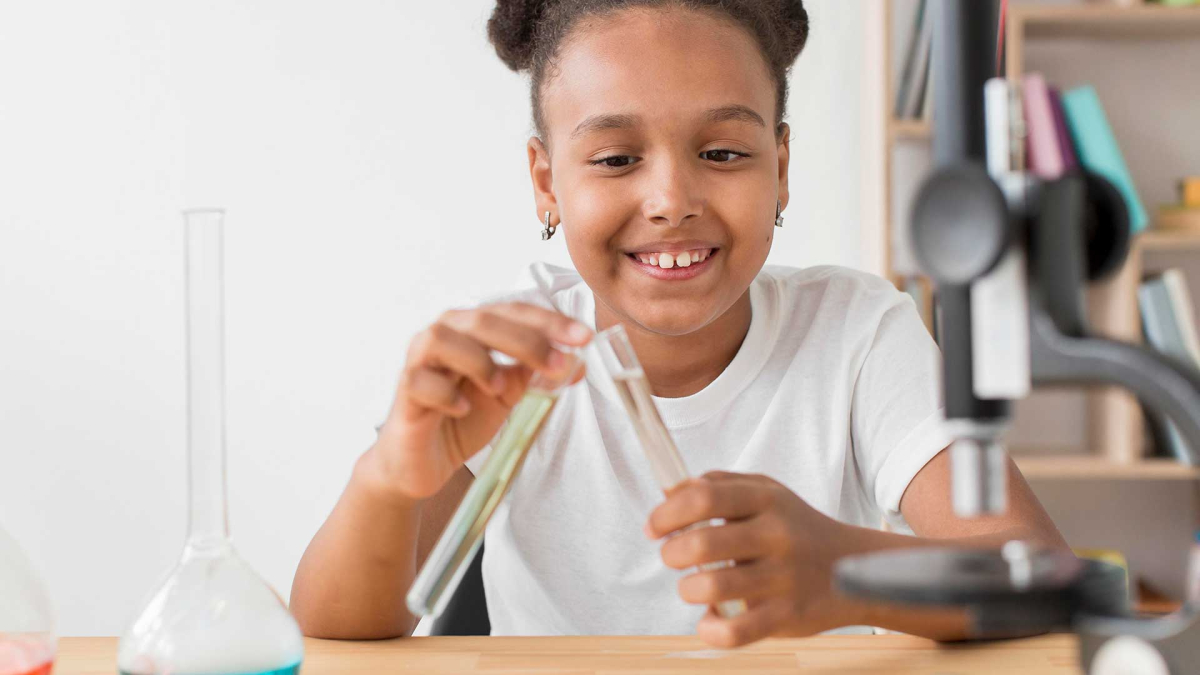
Elementary science education should ignite curiosity and provide young learners with concrete experiences that help them understand how the world works. At Wellspring Global Academy, we've designed our elementary science curriculum to prove that virtual learning can actually enhance hands-on discovery.
When students learn science at home, they can spend extended time with investigations, repeat experiments, and pursue their natural curiosity without rigid schedules or limited materials.
The Foundation: Inquiry-Based Learning
Building Natural Scientific Thinking
Elementary students are natural scientists who observe, question, and experiment constantly. Our curriculum builds on this curiosity by providing structured opportunities for guided discovery rather than rote memorization.
Core inquiry principles include:
- Starting with student questions and observations about their world
- Designing investigations that test hypotheses and answer real questions
- Using evidence to support conclusions rather than accepting information without investigation
- Communicating discoveries through various formats that build scientific vocabulary
- Connecting new learning to previous experiences and broader concepts
This approach helps students develop genuine understanding while building critical thinking skills that serve them across all subjects.
Virtual Tools That Enhance Discovery
Interactive Simulations and Models
Technology allows elementary students to explore concepts that would be impossible to investigate through direct observation alone. Interactive simulations make abstract concepts concrete while virtual models help students visualize complex processes.
Powerful virtual exploration tools:
- Ecosystem simulations that show how changing variables affects entire systems
- Weather models that demonstrate patterns and help students make predictions
- Simple chemistry simulations that show molecular behavior safely
- Physics demonstrations that illustrate gravity, motion, and energy transfer
- Virtual microscopes that explore cellular structures and microorganisms
These tools prepare students for meaningful hands-on investigations by building conceptual understanding first.
Digital Documentation and Analysis
Elementary students use age-appropriate technology tools to document investigations, organize observations, and analyze results while building digital literacy skills.
Students might use simple spreadsheets to track plant growth, graphing tools to visualize weather patterns, or digital journals to document experimental procedures and results.
Hands-On Investigations at Home
Kitchen Chemistry Adventures
The kitchen provides a fully equipped chemistry laboratory where elementary students can safely explore fundamental concepts about matter, chemical reactions, and material properties.
Safe kitchen chemistry includes:
- Exploring states of matter through cooking activities demonstrating solid, liquid, and gas transformations
- Understanding chemical reactions through baking experiments showing how ingredients combine
- Investigating solutions and mixtures by creating different drinks and observing dissolution
- Examining pH concepts using natural indicators like red cabbage juice with safe household materials
- Studying crystallization through salt and sugar experiments under different conditions
These investigations use familiar materials while teaching fundamental chemistry concepts that provide foundations for advanced study.
Backyard Biology Explorations
Home environments provide rich opportunities for biological investigations that connect students with local ecosystems while building life science understanding.
Biological investigation opportunities:
- Plant growth experiments tracking variables like light, water, and soil conditions
- Wildlife observation projects documenting local animal behavior and habitats
- Garden ecosystem studies exploring relationships between plants, insects, and organisms
- Composting investigations demonstrating decomposition and nutrient cycling
- Weather and climate data collection connecting to environmental conditions
These long-term investigations help students understand that science takes patience and careful observation while building environmental connections.
Curriculum Integration and Assessment
Cross-Subject Learning
Elementary science becomes more meaningful when it connects naturally with other subjects, helping students see that learning is interconnected.
Wellspring's elementary programs ensure that science learning enhances rather than competes with other subject areas while building comprehensive understanding across the curriculum.
Portfolio-Based Progress Documentation
Elementary science assessment captures the process of discovery rather than just final answers. Portfolio assessment allows students to document their learning journey while building reflection and communication skills.
Portfolio components include:
- Investigation journals showing question development and hypothesis formation
- Photo documentation of experimental procedures and results
- Data collection sheets demonstrating measurement and observation skills
- Reflection writing showing how thinking has changed through investigation
- Creative presentations that communicate findings to different audiences
Support Systems for Family Success
Educational Concierge Guidance
Wellspring's Educational Concierge services provide crucial support for families implementing hands-on science education at home, including activity planning, safety guidance, and troubleshooting support.
Parent Partnership Without Pressure
Parents don't need to become science teachers to support their children's elementary science education. Instead, they facilitate learning by providing materials, ensuring safety, asking thoughtful questions, and celebrating discoveries.
Effective parent support strategies:
- Gathering materials for investigations without explaining concepts beforehand
- Asking open-ended questions that encourage student thinking
- Documenting learning through photos and videos
- Connecting science learning to family interests and experiences
- Maintaining safe environments while encouraging appropriate exploration
Frequently Asked Questions
What supplies will we need for elementary science activities?
Most activities use common household items, though families may occasionally need to purchase specific materials like seeds or batteries. Supply lists are provided in advance, and activities are designed to be affordable and accessible.
Can my child safely conduct science experiments at home?
All activities are designed with safety as the top priority, using only safe household materials and age-appropriate procedures. Clear safety guidelines are provided for parents, and Educational Concierges offer additional guidance when needed.
How do I know if my child is learning what they need?
Progress assessment includes portfolio development, regular check-ins with Educational Concierges, and alignment with recognized elementary science standards. Students who engage actively in hands-on investigations typically develop stronger scientific thinking skills.
What if experiments don't work as expected?
Failed experiments provide excellent learning opportunities! Students learn that science involves testing ideas, analyzing unexpected results, and modifying approaches based on evidence. Educational Concierges help families use unexpected outcomes as teaching opportunities.
Science Discovery Starts at Home
Elementary science education should spark lifelong curiosity while building thinking skills that serve students across all learning areas. When science happens at home, students have the time, space, and support to pursue questions, test ideas, and develop genuine understanding.
The kitchen laboratory, backyard ecosystem, and living room engineering space become sites of authentic discovery when guided by expert teachers, supported by caring families, and enhanced by appropriate technology tools.
Discover how Wellspring's elementary science curriculum can bring authentic scientific discovery to your home while building the critical thinking skills your child needs for future success.