 Middle school gets a bad rap. It's awkward, they say. Kids are impossible. It's just about surviving until high school. But here's what gets lost in those dismissive narratives: middle school represents one of the most critical periods in intellectual development. Done right, these years build the thinking skills that determine success not just in high school, but in college and careers.
At Wellspring Global Academy, we approach grades 6-8 with the seriousness they deserve. This isn't about babysitting adolescents until they're ready for "real" learning. It's about developing the critical thinking, analytical reasoning, and independent learning skills that transform students from passive receivers of information into active thinkers who can tackle complex problems.
Why Middle School Matters More Than You Think
Something remarkable happens to the human brain during early adolescence. The prefrontal cortex—responsible for reasoning, planning, and complex thought—undergoes significant development. Abstract thinking becomes possible. Students can finally understand nuance, see multiple perspectives, and grapple with complexity in ways they couldn't at age ten.
Traditional middle schools often miss this window entirely. They're so focused on managing adolescent behavior and social drama that intellectual development takes a back seat. Students capable of sophisticated thinking spend their days on worksheets and low-level recall tasks. It's a waste of crucial developmental time.
We take a different approach. Our middle school curriculum capitalizes on emerging cognitive abilities by challenging students with authentic complexity. We ask them to analyze, evaluate, synthesize, and create—not just memorize and repeat. We treat them like thinkers capable of real intellectual work, because that's exactly what they are.
Building Critical Thinking Across Subjects
Critical thinking isn't a separate subject—it's woven through everything we teach.
English Language Arts: Beyond Comprehension Questions
In traditional middle school English, students often read books and answer comprehension questions: "What color was the car?" "Where did the character go?" These questions assess memory, not thinking.
Our English curriculum pushes deeper. Students analyze author's choices about structure and language. They evaluate how different perspectives shape narrative understanding. They synthesize themes across multiple texts. They create arguments supported by textual evidence.
When we read a novel, students don't just understand what happened—they grapple with why the author made specific choices and how those choices affect meaning. They debate interpretations. They write essays defending their analyses with evidence. They're doing the work of literary scholars, not just passing reading quizzes.
Mathematics: Understanding Concepts, Not Just Procedures
Middle school math is where many students decide they're "not math people." Usually that happens because they're taught procedures without understanding: "Do these steps to get the answer."
We flip that approach. Students understand why mathematical procedures work before memorizing how to execute them. They solve problems requiring multiple steps and strategic thinking. They explain their reasoning and evaluate whether answers make sense. They apply mathematics to real-world situations requiring judgment, not just calculation.
A student working on proportional reasoning doesn't just cross-multiply. They understand the relationship between quantities, recognize proportional situations in different contexts, and solve real problems where proportional reasoning matters—like scaling recipes, calculating travel times, or analyzing data patterns.
Science: Thinking Like Scientists
Science becomes exciting in middle school because students can finally engage in genuine scientific thinking. They're not just learning facts about photosynthesis—they're designing experiments, analyzing data, and drawing conclusions.
Our project-based approach puts students in the role of scientists investigating questions. They form hypotheses based on existing knowledge. They design experiments to test those hypotheses. They collect and analyze data. They evaluate whether their evidence supports their conclusions. They revise their understanding based on new information.
This process—questioning, investigating, analyzing, concluding—represents how science actually works. Students learn content, but more importantly, they learn to think scientifically.
Social Studies: Multiple Perspectives and Complex Analysis
Middle school social studies covers everything from ancient civilizations to modern government. In traditional classrooms, this often means memorizing dates, names, and facts for tests.
We focus instead on historical thinking. Students analyze primary source documents, evaluate different interpretations of events, understand how geography and resources shape societies, recognize patterns across time periods, and construct arguments about historical causation.
When studying ancient Rome, students don't just memorize emperor names. They analyze how geographic advantages supported Roman expansion, evaluate different perspectives on whether Rome was a civilizing force or imperial oppressor, compare Roman governance to other ancient systems, and synthesize understanding across political, social, economic, and cultural dimensions.
Developing Independent Learning Skills
Maybe the most important thing middle school students need to learn is how to learn. High school teachers expect independence that many students haven't developed. We build those skills intentionally.
Organization and Time Management
Middle school is when students transition from parents managing their work to managing it themselves. This doesn't happen automatically—it requires explicit teaching and practice.
Our students learn to track multiple class assignments, prioritize tasks based on deadlines and importance, estimate how long tasks will take, plan backwards from due dates, use organizational systems that work for their specific brains, and monitor their own progress and adjust plans accordingly.
Your Educational Concierge partners with families during this transition, providing structure that gradually releases as students develop capability. By eighth grade, most students manage their work independently with minimal parental involvement.
Self-Advocacy and Communication
In elementary school, parents typically communicate with teachers about student needs. In high school, students must advocate for themselves. Middle school is when we develop that capacity.
Students learn to identify when they're confused or struggling, ask specific questions rather than saying "I don't get it," communicate with teachers about challenges or conflicts, participate actively in discussions about their learning, and take responsibility for their academic outcomes.
This isn't about blaming students for struggles—it's about empowering them to be active participants in their education rather than passive recipients.
Study Skills and Learning Strategies
Different subjects require different learning approaches. Reading a novel requires different skills than studying for a math test. Writing a research paper needs different strategies than preparing a science presentation.
We explicitly teach these varied approaches. Students learn note-taking systems that work for different subjects, active reading strategies for comprehension and retention, methods for studying that go beyond rereading, approaches to tackling complex multi-step projects, and metacognitive awareness of their own learning processes.
Students discover how they personally learn best and develop toolkit of strategies they can deploy appropriately.
Project-Based Learning in Middle School
Abstract thinking enables middle schoolers to tackle complex, extended projects in ways elementary students can't. Our project-based approach capitalizes on this capability.
Students might design sustainable city plans that integrate environmental science, economics, and social planning. Create documentary films analyzing historical events from multiple perspectives. Develop mathematical models solving community problems. Research and present on topics they're genuinely curious about.
These projects require sustained effort, managing multiple components simultaneously, synthesizing information from diverse sources, applying knowledge to novel situations, and producing polished work for authentic audiences.
The skills developed through project-based learning—planning, research, analysis, creation, revision—transfer directly to high school AP courses and college work.
Personalization for Diverse Middle Schoolers
Middle school students vary enormously in academic readiness, interests, and learning needs. Our online model enables personalization impossible in traditional classrooms.
For students who need additional support: Flexible pacing allows mastery before advancing. Additional instruction through office hours and small-group sessions provides targeted help. Alternative assessment formats demonstrate understanding in varied ways. Educational Concierge coordination ensures consistent support.
For advanced students: Accelerated pacing through content enables deeper or broader study. Enrichment projects pursue interests beyond core curriculum. Early introduction to high school content or AP-level work challenges ready students. Mentorship opportunities with teachers having specialized expertise.
For students with learning differences: Multi-modal instruction addresses diverse learning styles. Scaffolded support builds skills progressively. Assistive technology integrates seamlessly. IEP and 504 accommodations implement fully.
The Social-Emotional Dimension
Middle school brings significant social-emotional development alongside intellectual growth. We don't ignore this reality—we integrate support intentionally.
Students need to develop emotional regulation skills, navigate changing friendships and social dynamics, build confidence in their emerging identities, and learn to manage increasing academic pressures healthily.
Our advisory program provides regular check-ins with dedicated mentors. Small class sizes mean teachers actually know students well. The online environment reduces social pressures that overwhelm some middle schoolers. And Educational Concierges monitor not just academic progress but overall student wellbeing.
Preparing for High School Success
Everything we do in middle school points toward high school readiness. Students who complete our 6-8 program enter ninth grade prepared for advanced coursework.
They have strong foundational knowledge in core subjects. They possess critical thinking skills essential for complex analysis. They've developed organizational and study habits that support independent learning. They can advocate for themselves and communicate with teachers effectively. They understand how they learn best and have strategies for tackling challenges.
Perhaps most importantly, they see themselves as capable thinkers who can handle difficult material. That identity as a learner matters as much as any specific content knowledge.
What This Looks Like Daily
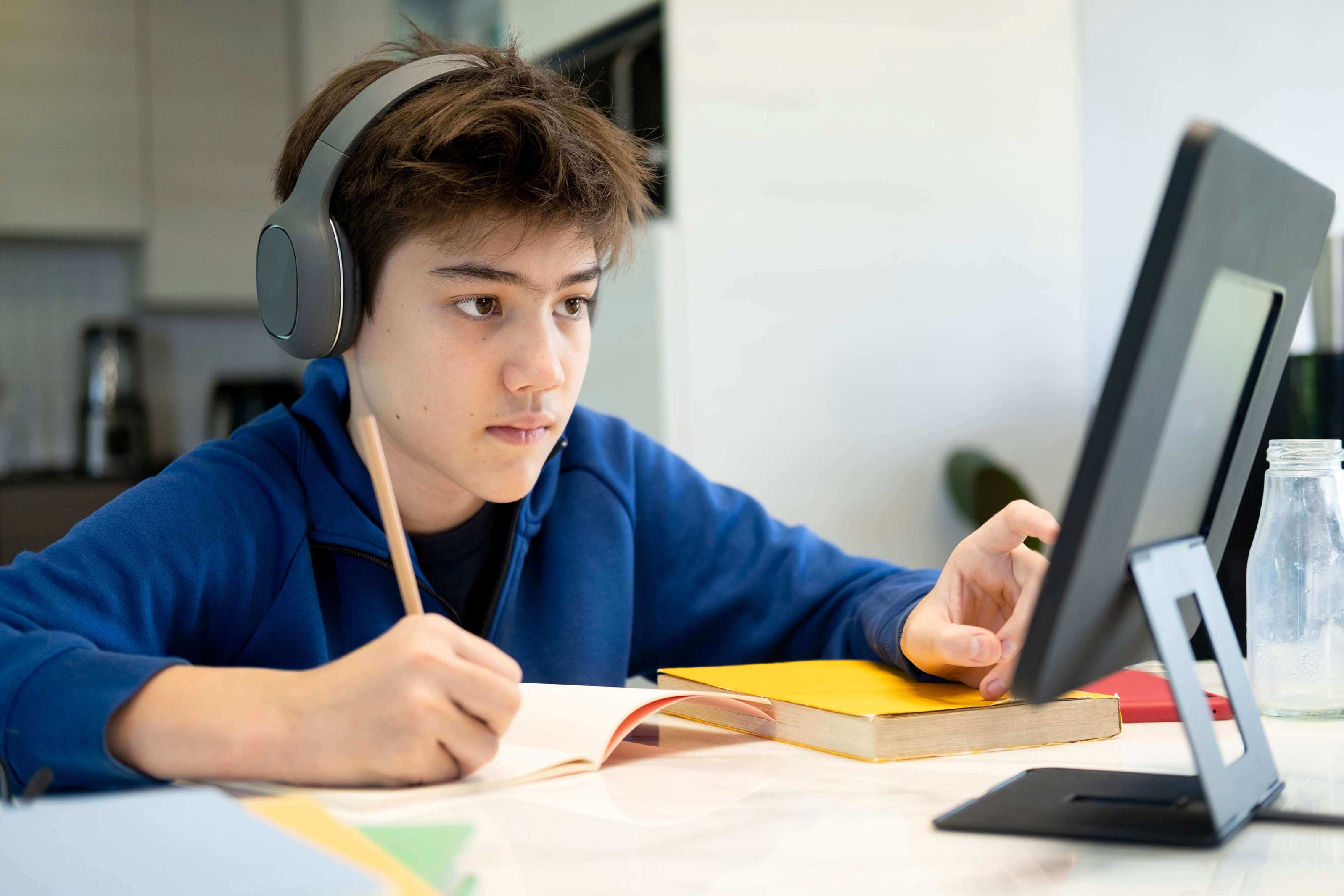
A typical day for a Wellspring middle schooler involves morning live sessions in core subjects with interactive discussions and collaborative work. Independent work applying concepts, completing assignments, or working on projects. Office hours with teachers for questions or additional help. Elective classes exploring interests from coding to art to world languages. Virtual clubs or activities connecting with peers around shared interests. And time for physical activity, family, and personal interests—because middle schoolers need lives beyond academics.
The daily workload is rigorous but manageable, typically 4-6 hours of focused academic time plus additional time for reading, projects, or activities. This leaves space for adolescents to be adolescents—developing identities, pursuing passions, and spending time with families.
Ready to Learn More?
If you're looking for middle school education that actually prepares students for higher-level thinking rather than just managing them until high school, Wellspring Global Academy offers a substantive alternative.
Our curriculum challenges students intellectually while supporting them developmentally. We treat middle schoolers like the capable thinkers they are while providing structure and support they still need. We build skills that matter for long-term success, not just for passing eighth grade.
Explore our middle school program or schedule a consultation to discuss how our approach might work for your middle schooler. Connect with our Educational Concierge team to learn about the personalized support that helps middle school students thrive.
Middle school doesn't have to be about survival. It can be about genuine intellectual growth.